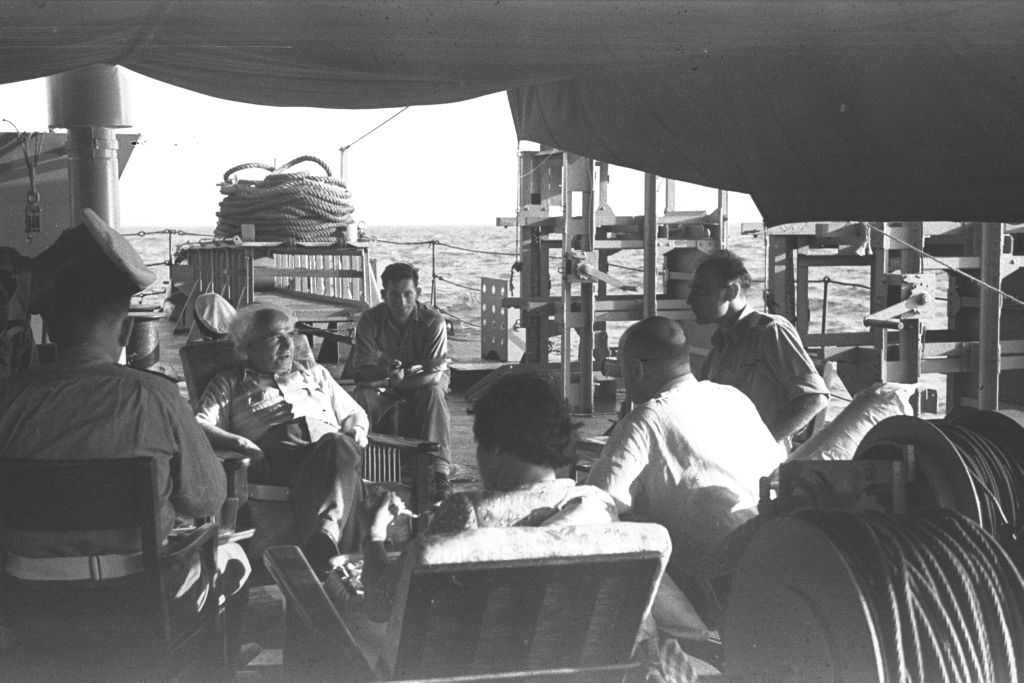
Ben-Gurion could never have declared a state in May 1948 without first painstakingly transforming Palestine’s ragtag Jewish militias into an army

What was David Ben-Gurion’s most significant accomplishment? Most people would probably choose the declaration of the State of Israel. In retrospect, however, even more important than creating the state were his efforts to ensure its survival.
Has the Old Man Lost His Mind?
As soon as he was assigned the defense portfolio at the Jewish Agency (later to become Israel’s provisional government) in 1947, Ben-Gurion organized his own crash course to bring himself up to date. For several weeks, he met with representatives of each branch of the defense establishment and studied the organizational structure of the security forces –Hagana. He checked out its equipment, commanders, and strategy, the kinds of threats it was prepared to repel, as well as the strength and capabilities of the Arab enemy forces. His conclusions were radical – as was his reaction. He replaced several of the Hagana’s leading figures and, more important, created a significant shift in its thinking. Hagana activists were still gearing up to fight yesterday’s war – an intensified replay of the civil unrest and riots of the Arab Revolt a decade earlier. Ben-Gurion demanded that his troops be prepared to face organized, fully equipped military forces – the armies of the neighboring Arab states, including the Arab Legion stationed in Transjordan – rather than the local rabble and volunteer units his commanders expected. Hearing Ben-Gurion’s insistence on a real army, complete with tanks, planes, cannons, and battleships, many of his colleagues declared the old man out of his mind.
Not surprisingly, Ben-Gurion didn’t achieve all his goals before independence. The Hagana was fully restructured only later; during the War of Independence, almost all the prominent commanders were former members of Hagana or Palmah (its standing militia), and only a few had been formally trained by the British army. But Ben-Gurion’s success in shifting attention to the impending military threat proved critical. As a result of his vision, tremendous energies were diverted to acquire planes, tanks, and cannons during the months preceding the declaration of the State of Israel – most of which arrived in the course of the War of Independence. It is appalling to imagine the fate of the Jewish community had its security forces fought that war equipped solely with the two tanks (only one of which worked) and the single fighter plane they’d had when the state was declared. The Arabs had dozens of tanks and aircraft at their disposal, and no lack of ammunition. Thanks to Ben-Gurion’s ongoing efforts, fighter planes and weapons were purchased from Czechoslovakia in 1947–8, volunteers were recruited from Jewish communities worldwide as of January 1948, and ships loaded with firearms and ammunition sailed from Europe and the United States. Without the resulting shift in the balance of power, giving the IDF an advantage over the Arab forces on nearly all fronts by early 1949, the State might never have been established, let alone been able to defend itself.

A United Army
Ben-Gurion’s military strategy in the War of Independence has generated extensive discussion, eliciting effusive praise from some quarters and the harshest criticism from others. His insistence on forcing a route to Jerusalem resulted in the tragic battles at Latrun; his bold, if not crude attempts to restructure the military led to “the Generals’ Revolt,” in which nearly the entire Hagana command threatened to resign one week before the State of Israel was declared; his central role in the destruction of the Irgun militia’s weapons on the Altalena evokes fistfights to this day; and many still resent his ruthless dissolution of Palmah after the war. Although these incidents are not usually linked, they all ensured the formation of a unified army subordinate to Israel’s political leadership.
Shortly after the State of Israel was established, a group of Palmah intellectuals including Natan (Yonatan) Klein, Haim Gurfinkel (Gouri), and Haim Feiner (Hefer) demanded that Ben-Gurion disband the Irgun and Stern Gang militias, which refused to accept central authority. Responsibility for all military operations, the group argued, should be transferred to Hagana, which was closely aligned with the state leadership. When he felt the time was ripe, Ben-Gurion acted mercilessly. Sinking the Altalena with all the ammunition on board was a price he was prepared to pay, though all the Jewish militias desperately needed weapons, and despite the fact that his decision nearly led to civil war. The Tel Aviv Palmah activists who willingly executed the operation had no idea that to Ben-Gurion’s mind, they posed a similar danger of insubordination.
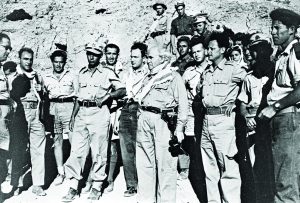
Ben-Gurion also considered the alliance between Palmah and the National Kibbutz Association, associated as it was with Mapam (the United Workers Party), a significant threat. These concerns, together with his determination to rebuild the IDF as a regular army along the lines of the British model, led him to defiantly dissolve Palmah only months after the State of Israel had been established. Ben-Gurion was well aware of Palmah’s crucial contribution to Israel’s victory in the War of Independence, but he also realized that the organization saw itself as an elite and refused to take orders from above. As poet Natan Alterman wrote in his weekly column in Davar a week before independence, Palmach was an organization “that refused to leave any of the work to ‘outsiders,’… who write their own odes and have already set down their own version of history.” (“The Seventh Column,” Davar, 28 April 1948)
Not yet a Segula subscriber?
Access our full archive online, have print issues delivered to your door, and moreFeel free to share