Despite their historic ties to diverse European communities, the Jews of Turin stood out as active players in the struggle for a united Italy – and planned a synagogue to match their achievements

Embossed on the obverse side of the two-cent Italian Euro coin, the Mole Antonelliana is one of the most famous buildings in Europe and the emblem of the city of Turin. Upon completion in 1900, the Mole was the tallest structure in Europe after the Eiffel Tower. There is something undeniably megalomaniac about its design: its spire thrusts from the tangle of surrounding buildings as if determined to make a point, and there is no angle in the immediate vicinity from which one can capture its full height in one glance or camera shot.
The builders of the Mole did indeed have a very definite point to make: when construction began in the 1860s, Turin was the provisional capital of a newly united Italy and the seat of a monarchy riding a wave of romantic patriotism. Rising phoenix-like after centuries as a loose collection of principalities, Italy was just entering the modern world.
Perhaps the most fascinating aspect of the Mole, however, is not the megalomania of architect Alessandro Antonelli – who dragged out the project until he died – but the building’s original purpose: to serve as the flagship synagogue of the capital’s Jewish community. What chutzpa: the Jews, who just a few years previously had still been confined to the cramped ghetto, were occupying the civil heart of the city. And in defiance of the old order, under which no building could be taller than the city’s churches, the Jews’ house of prayer loomed over the entire area. Even today, none of the Gothic cathedrals on the continent come anywhere near the Mole’s 167-meter height (though the Sagrada Família in Barcelona is slated to surpass it).
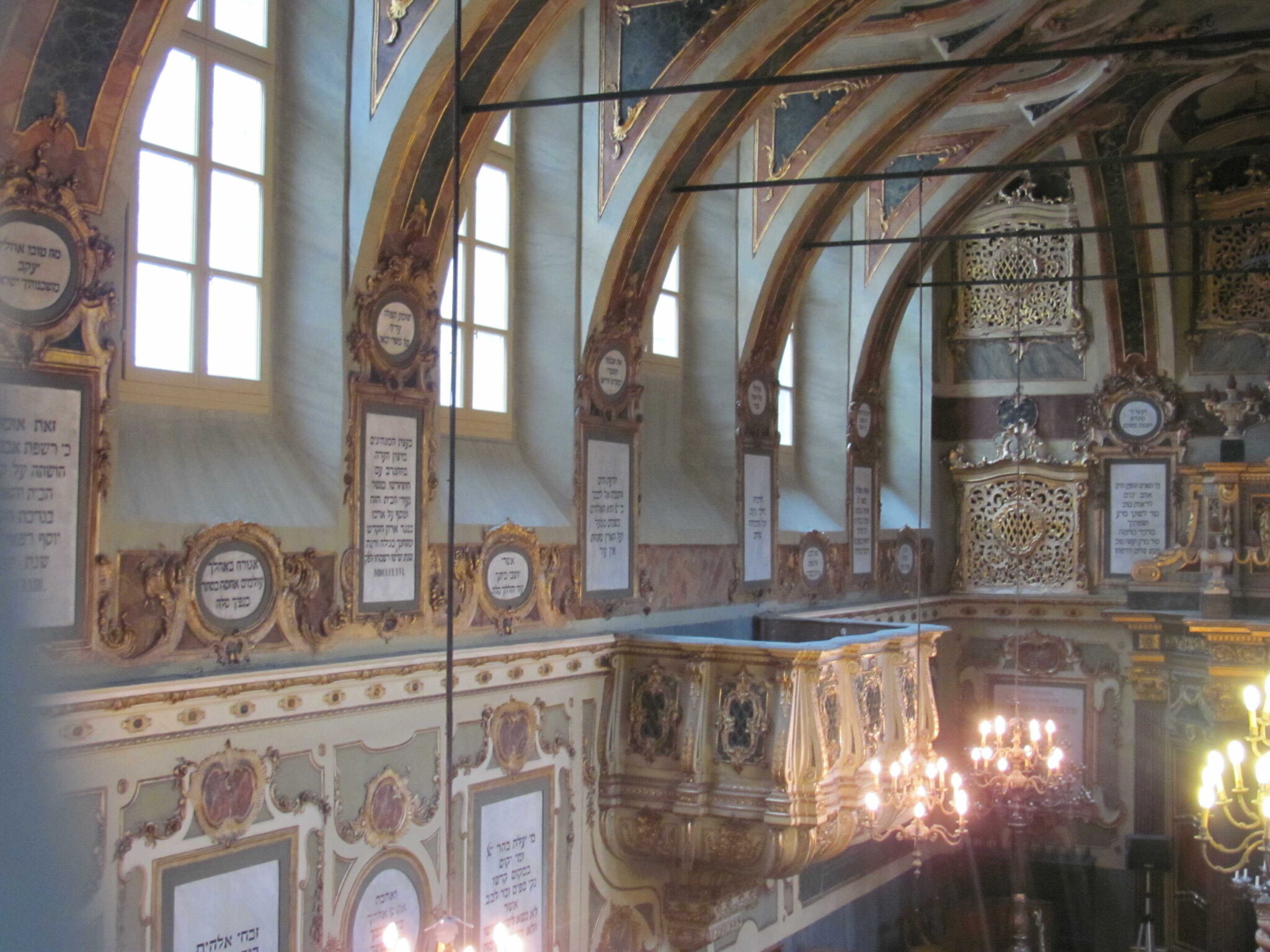
The Mole never actually functioned as a synagogue. As construction costs spiraled and delays multiplied, Turin was superseded as the capital of Italy by Florence (in 1865) and then, six years later, by Rome. The town’s Jewish population shrank substantially, making the ambitious project superfluous. The community handed the unfinished building over to the Turin municipality in return for a vacant lot on which it erected a far less imposing synagogue, which operates to this day. Meanwhile, the Mole has gone through various incarnations, the most popular of which is probably the current one: the Italian national museum of cinema.
The secret of the Turin Jewish community’s self-confidence lies in the beginning of the modern period, when Italy embarked on unification.

Mole Antonelliana, originally designed as a synagogue | Photo: Yoav Sorek

Turin, an Italian city in the foothills of the Alps. The soaring spire dwarfing the church to its left belongs to the Mole Antonelliana, originally designed as a synagogue | Photo: claudiodivizia, Istock
Not yet a Segula subscriber?
Access our full archive online, have print issues delivered to your door, and moreFeel free to share