
It’s no coincidence that a “l’chaim” is a key feature of every eastern European Jewish tale. Why were Jews the region’s primary manufacturers, traders, and even servers of alcohol – and how did it shape their lives?// Shalom Boguslavsky

Forget doctors and lawyers. The most Jewish profession in the world – historically, at least – is actually bartending. Anyone trekking across central Poland to the Dnieper River in the 18th and 19th centuries knew whom to look for when seized by a sudden thirst: the Jew behind the bar in one of thousands of alehouses along the way. For some two hundred years, spirits were an almost exclusively Jewish industry, especially in non-urban areas. Roughly a third of eastern European Jewry, which then constituted more than half the global Jewish population, was either directly or indirectly involved in distilling, bottling, merchandising, and/or serving alcohol.
Ever since Hellenistic times, Jews have preferred urban life and tended toward commodities and finance, and all three elements have shaped the Diaspora. Medieval rulers saw Jews as a potential boost to the economy and appreciated the international contacts they could place at a prince’s disposal. These connections made Jews ready diplomats and bankers, and their services earned them the privilege of living in certain lands. European powers likewise tolerated Jewish doctors and international merchants but didn’t encourage the settlement of petty traders and peddlers, shoemakers, or wagon drivers.
Relegated to limited residential areas of western and central Europe, Jews were often expelled from there too as their number expanded. Many found a new home in eastern Europe, particularly in the Polish Lithuanian Union. As the authorities struggled to extend their control of the region’s fertile eastern reaches, urban professionals were much in demand. Jews therefore settled in the periphery, braving occasional raids by slave-trading Tatars, uprisings by Cossack bands supposedly protecting the locals from Tatar aggression, civil wars, and invasions by Russia and Sweden. These and other unsavory circumstances made the area far from desirable for anyone with the luxury of choice. Thus, in the mid-16th century, the town of Kremenets, in western Ukraine, absorbed only twelve Poles, three Germans, and one Czech but sixty-seven Jews. The farther east, and the wilder the terrain, the greater the proportion of Jews among the migrant population.
Accordingly, Jewish settlement fanned out eastward from Kraków to today’s eastern Poland, Belarus, and central and western Ukraine. For centuries, this was the most Jewish region in the world.

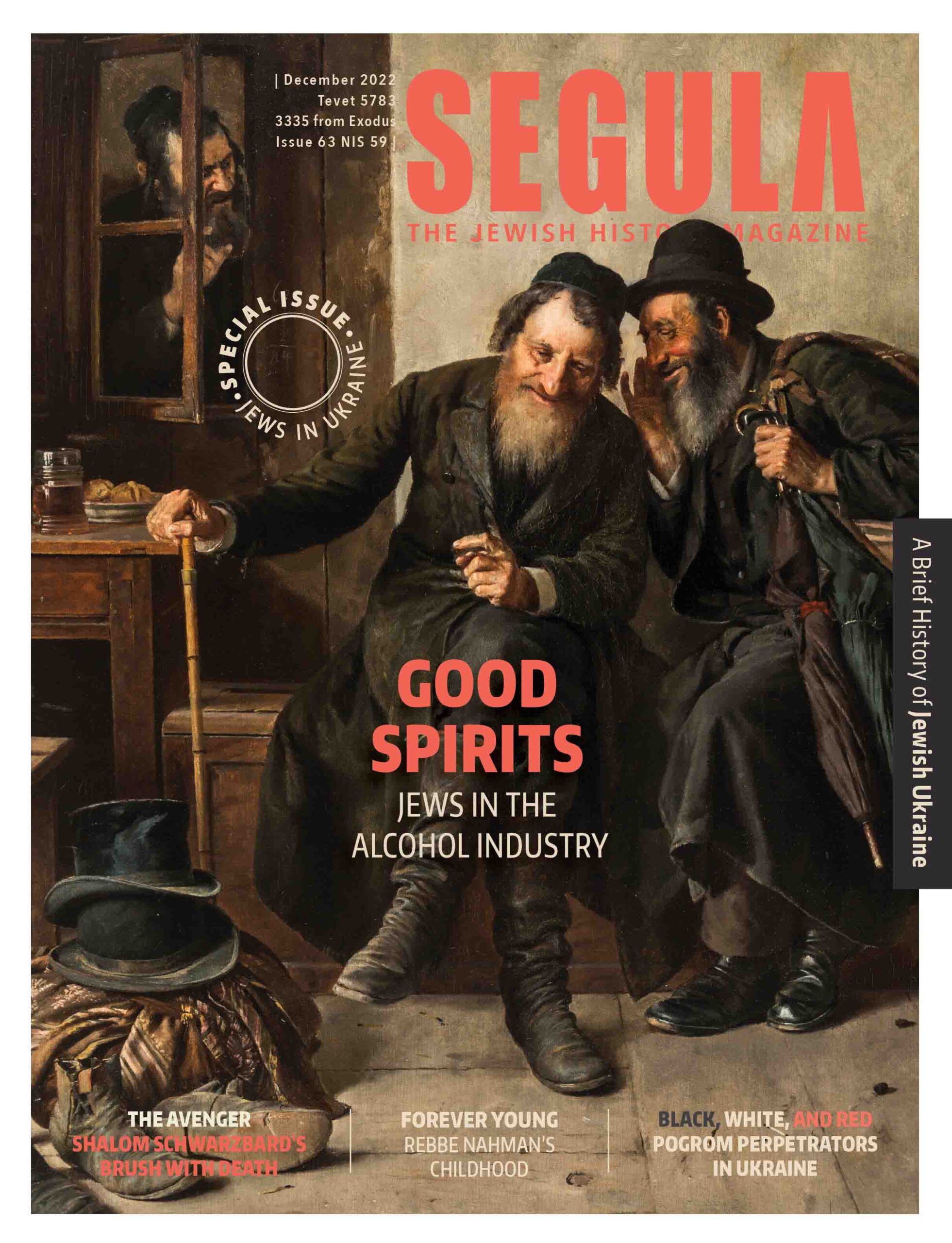
About a third of eastern European Jewry made a living in the alcohol industry. In a Tavern in Podolia, Jan Maszkowski, 19th century | Courtesy of the Lviv National Art Gallery

Baczewski’s Premium Vodka. In 1782, the Baczewski family operated the first modern distillery. Vodka ad, 1914 | Photo: Silar
Grain in a Glass
Jews established themselves en masse in hundreds of new small towns, derided as “shtetls,” where they worked primarily as leaseholders, traders, middlemen, and administrators. They were a vital link in the chain that monetized the breadbasket of Europe, further enriching the estateowning nobility. Wheat and other grains were exported mostly via the Polish port of Gdansk (which the Germans called Danzig).
By the 18th century, however, the profitability of this trade was declining. Russia controlled fertile regions in eastern Ukraine, the Caucasus, and Siberia, developing them for all their worth. Grain prices tumbled as a result of this competition, and advances in storage and preservation made matters worse by bringing American grain exports to the European market. Supply outstripped demand, and many countries passed “corn laws” taxing cheap grain imports to protect local farmers. Landholders in the Polish-Lithuanian Commonwealth found themselves with mountains of grain but few takers.
This problem led to a creative solution: converting the surplus into a form the farmers themselves would happily pay to soak up – alcohol. Just a few vats and pipes could turn cheap, readily available grain into a luxury item. Alcoholic beverages were easily transportable and had an exceedingly long shelf life, plus they were highly addictive.
The landed gentry had been cultivating a liquor industry for centuries; the stable value of the spirits they manufactured protected them somewhat from fluctuating grain prices. But whereas previously they’d produced relatively inexpensive beer and meads, with stronger stuff being too expensive to manufacture in large quantities, the plummeting cost of grain in the 18th century altered the equation. New technologies allowed for the mass production of what was known in Polish as gorzalka and in Ukrainian as horilka – both derived from each language’s word for “fire.” Jews referred to the beverage as “burned wine,” abbreviated in Hebrew as yash. Most people now use its Russian name: vodka.

Today’s vodka is very different from the concoction that was marketed to Ukrainian farmers. The original version was distilled to less than 40 percent alcohol and – to mask its bitterness – flavored with fruit, spices, pine needles, and aromatic roots and vegetables. The vodka we drink is diluted with water to 40 percent alcohol and cleansed of any aftertaste during distillation. This process was pioneered by the Baczewski family, Jews from Lviv who specialized in vodka manufacture from the end of the 1700s until World War II. In one of the first modern advertising campaigns, they repackaged the popular, down-market beverage as “Premium Vodka,” fit for the most genteel salon.
Vodka-Driven Politics
Alcohol import and production were generally controlled by Jews, and not only because their network of cross-border contacts with Jewish communities made it easier for them to supply goods from further afield. As every Jewish family needed wine to sanctify the Sabbath each week, Jews living in regions unsuited to grape cultivation – as was most of the Polish-Lithuanian Commonwealth – were dependent on imports. The nearest vintners were in the Ottoman Empire, whose northern border – until the late 18th century – ran through today’s southern Ukraine. The second-largest concentration of Jews in the world – Ladino-speaking Sephardim – lived across this border.
It was, of course, no coincidence that Jews lived in such great numbers on both sides of the boundary between the Ottoman Empire and the Polish-Lithuanian Commonwealth. The kinship between these Jewish communities came in very handy when middlemen were required to bridge the gap between Christian Europe and the Muslim world. Economics and diplomacy went hand in hand here. The most famous example is Don Joseph Nasi, duke of the Ottoman island of Naxos, who acted as go-between for Sultan Selim II and Sigismund Augustus, duke of Lithuania and king of Poland, at the end of the 16th century. Among other licenses, Don Joseph imported large quantities of wine from the Ottoman Empire to Poland. Running this operation out of Lviv, he encouraged Sephardic Jews to resettle in Poland.
By the early 19th century, vodka provided Polish nobles with almost half their income. As a mainstay of the Polish economy, the liquor naturally gave rise to fierce political bickering. From the 16th century onward, “magnates” – noblemen controlling vast tracts of land – vied with the kings of Poland for authority. Some land barons wielded such power that they even formed private armies, leaving the royals more or less figureheads. Thus, although legally a monarchy, Poland was essentially a republic in which only the nobility had the right to vote. As the nobles depended on their estates for income, vodka production became the aristocracy’s top priority – at any price.

Not yet a Segula subscriber?
Access our full archive online, have print issues delivered to your door, and moreFeel free to share