
Recent discoveries at prehistoric sites in Israel are overturning decades of conventional wisdom. Could Neanderthals have coexisted with modern man on this land bridge between Asia, Europe, and Africa? And who was the common ancestor of us all?

The entire world is populated by a single species of man – modern man, otherwise known as Homo sapiens sapiens (a subspecies of Homo sapiens). Prehistoric remains have made us aware of other human species, preceding or coexisting with the earliest modern humans. The material culture they left behind – graves, food, tools, etc. – allows us to reconstruct their surroundings and analyze the development of our species. From the rich archaeological record revealed by past and ongoing excavation in Israel, it is abundantly clear that this area of the Middle East played a crucial role in these evolutionary processes.
The land of Israel was uniquely suited to prehistoric man’s nomadic existence. The varied climate in the region created multiple ecosystems, providing a wide variety of food sources. Located at the crossroads of Africa, Europe, and Asia, prehistoric Israel offered a preferred route for the first hominids to leave Africa and spread across other continents.
Homo erectus, or upright man, was the first hominid to venture out of Africa and populate areas of Europe and Asia over 1.5 million years ago. Approximately five hundred thousand years ago, distinct populations began developing in different regions. Neanderthals evolving in isolated Europe during the Ice Age adapted their lifestyle to the frigid surroundings. Their DNA and skulls developed differently from that of Homo sapiens, and their skeletons grew thicker.
The earliest Neanderthal remains discovered in Europe have been dated to approximately four hundred thousand years ago. For millennia, Neanderthals were the only humans on the continent, from which they spread into West Asia. They never made it to Africa, and evidently became extinct some thirty thousand years ago, when modern man reached Europe in the Upper Paleolithic era.
Did you know?
Galilean Man

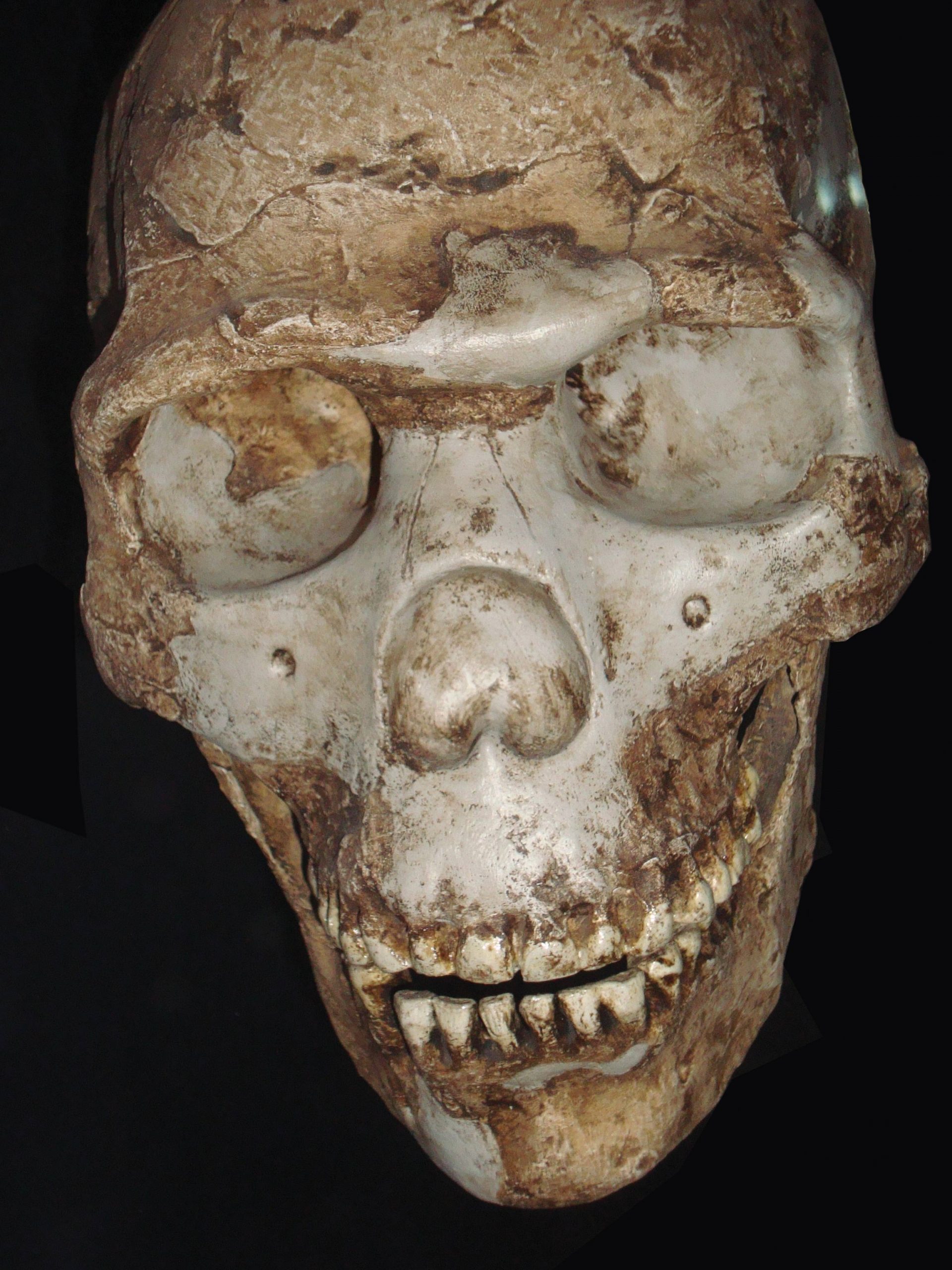
Prehistoric material cultures are often named for the places where they were first discovered. Mousterian culture is named for Le Moustier, a rock shelter in the Dordogne region of France, where flintwork found to be typical of Neanderthal sites first came to light. Aurignacian culture, found from Spain to the Crimea, is so called because it was first seen in Aurignac, in southern France. A number of prehistoric human subspecies are also named after the excavation sites where the earliest examples of their remains were found. Neanderthals, for example, were found in the Neander Valley, in Germany. When a fragment of a seemingly unique skull was unearthed in the Zuttiyeh Cave, near Wadi Amud, it was dubbed Galilean Man, after the region of northern Israel where it was found. Recent research has concluded that the fragment doesn’t represent a separate subspecies, but belongs to a previously identified type of early man.
Not yet a Segula subscriber?
Access our full archive online, have print issues delivered to your door, and moreFeel free to share